

In electronics, some laws feel less like equations and more like common sense. Kirchhoff’s Voltage Law (KVL) is one of them. It quietly governs everything from a simple LED circuit to complex power electronics systems—making sure voltages add up and energy is conserved.
Whether you’re a beginner learning circuit analysis or an engineer designing real-world systems, understanding KVL is essential.
What Is Kirchhoff’s Voltage Law?
Kirchhoff’s Voltage Law states:
| In any closed loop of an electrical circuit, the algebraic sum of all voltages is equal to zero.
Mathematically:
∑V=0
This means:
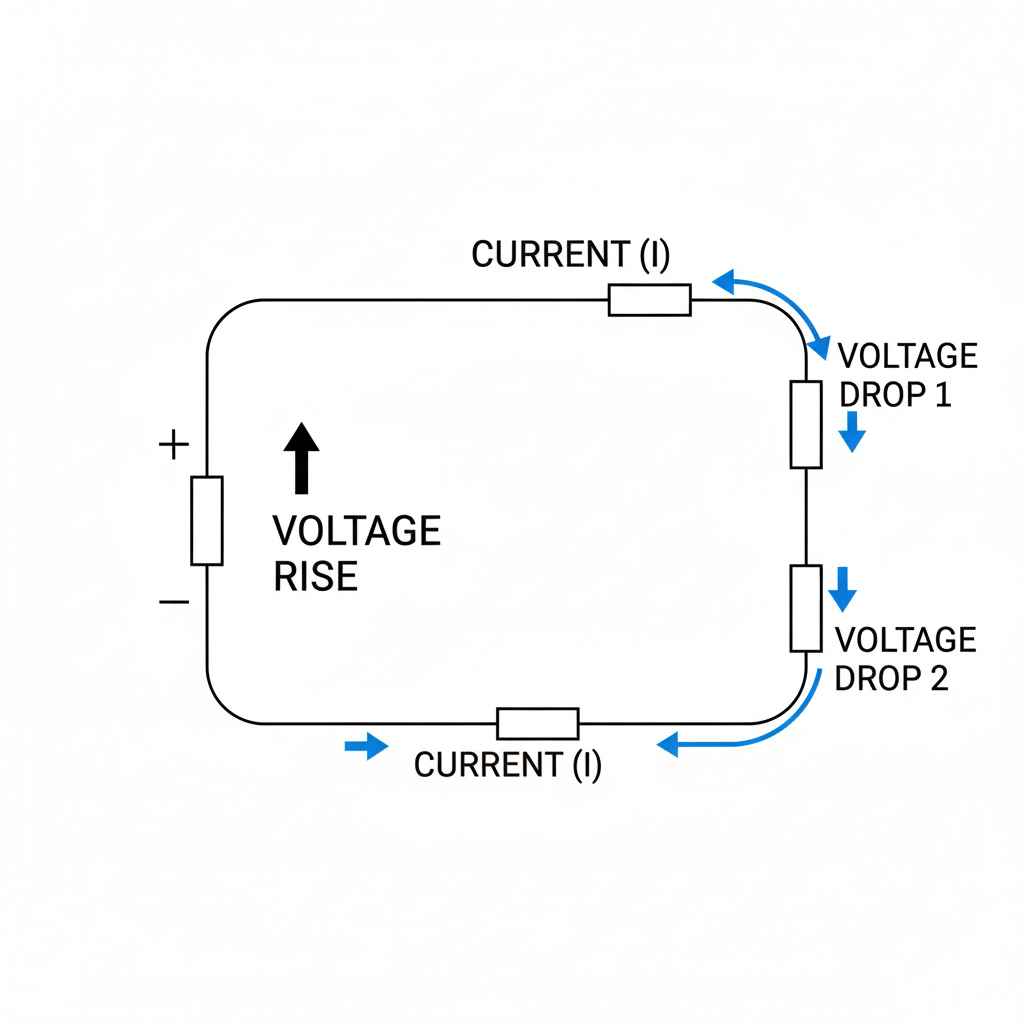
Voltage gains (from sources like batteries or power supplies)
Must equal voltage drops (across resistors, LEDs, capacitors, etc.)
No voltage magically appears or disappears inside a loop.
Why Does KVL Work?
KVL is a direct consequence of the law of conservation of energy.
Think of voltage as energy per unit charge:
A battery gives energy to charges
Components use up that energy
Once the charge completes a full loop, the net energy change must be zero. Otherwise, we’d be creating free energy—which physics doesn’t allow.
A Simple Real-Life Analogy
Imagine walking around a hill:
You climb +10 meters up
You walk down −10 meters
After completing the loop, you’re back where you started.
Voltage works the same way in a closed circuit loop.
Applying KVL to a Simple Circuit
Example: Single Loop Circuit
Components:
9V battery
Two resistors: R₁ = 3Ω, R₂ = 6Ω
Step 1: Assume Current Direction
Assume clockwise current (you can choose any direction).
Step 2: Write the KVL Equation
+9V−I(3Ω)−I(6Ω)=0
Step 3: Solve
9−9I=0 I=1A
KVL helps you find unknown currents and voltages with ease.
Sign Convention in KVL (Very Important!)
When writing KVL equations:
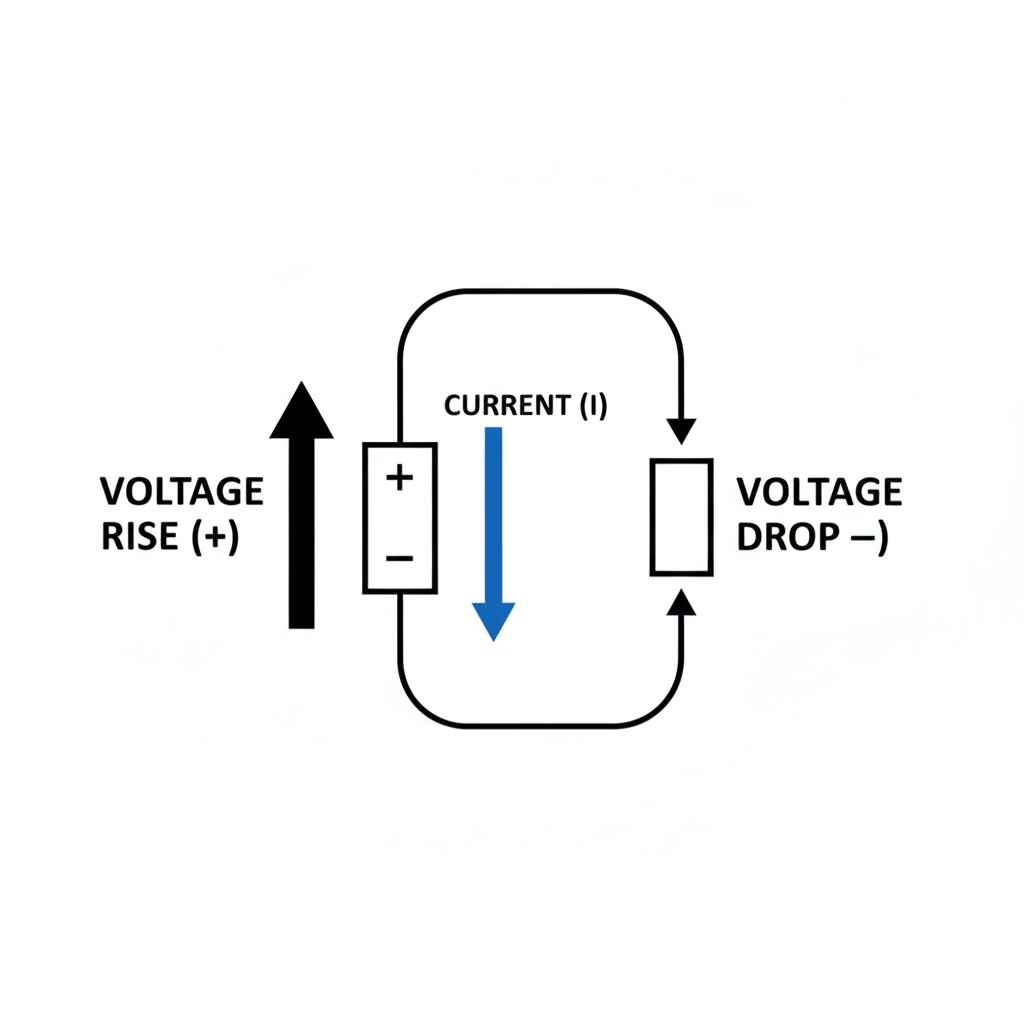
Voltage Rise (+)
Moving from negative to positive terminal of a source
Voltage Drop (−)
Moving across a component in the direction of current
Consistency matters more than direction. If your answer is negative, it just means the actual current flows opposite to your assumption.
KVL in Complex Circuits
For circuits with multiple loops, KVL is used with:
Mesh (Loop) Analysis
Simultaneous equations
Each independent loop gets its own KVL equation, making it possible to solve even very large networks.
Where Is KVL Used in Real Life?
Kirchhoff’s Voltage Law is everywhere:
Power supplies and adapters
Arduino and microcontroller circuits
Analog IC design
Motor drivers and inverters
Power electronics (SMPS, GaN & SiC devices)
PCB design and debugging
At Pluntx, KVL forms the backbone of circuit validation before moving to prototyping or manufacturing.
Common Mistakes to Avoid
Mixing up voltage rise and drop signs
Forgetting that KVL applies only to closed loops
Ignoring internal resistance of sources
Inconsistent current direction assumptions
Kirchhoff’s Voltage Law vs Ohm’s Law
| Law | Purpose |
|---|
| Ohm’s Law | Relates voltage, current, resistance (V = IR) |
| KVL | Ensures total voltage balance in a loop |
Ohm’s Law works inside components -> KVL works around loops
They are most powerful when used together.
Final Thoughts
Kirchhoff’s Voltage Law may look simple, but it’s one of the most powerful tools in electronics. Once you truly understand KVL, circuit analysis stops feeling like math—and starts feeling like logic.
Every closed loop tells a story. KVL just makes sure the story makes sense.
About pluntx

Pluntx is India’s leading platform for electronics and 3D printing solutions, offering a wide range of products like Arduino, Raspberry Pi, drone parts, sensors, 3D printer components, and more. We also provide expert CAD design services and affordable 3D printing, starting at just ₹49. Click here to explore our extensive collection of electronics and prototyping tools. Be sure to follow us on Instagram and YouTube, where we regularly share tutorials, tips, and updates on everything from Arduino projects to drone technology. Pluntx delivers precision and quality. Our mission is to empower creativity through technology and simplify the journey from concept to creation.



Thanks in support of sharing such a fastidious thinking, article is fastidious, thats why i have read it completely
Hi there, I wish for to subscribe for this web site to take latest updates, therefore where can i do it please help.
Hi! Quick question that’s completely off topic. Do you know how to make your site mobile friendly? My site looks weird when browsing from my iphone 4. I’m trying to find a template or plugin that might be able to correct this problem. If you have any suggestions, please share. Thank you!
It’s an remarkable piece of writing in support of all the online people; they will obtain benefit from it I am sure.
Wow, wonderful blog layout! How long have you ever been running a blog for? you make running a blog look easy. The whole look of your web site is magnificent, as well as the content material!
Its like you read my thoughts! You seem to grasp a lot approximately this, like you wrote the e book in it or something. I think that you just could do with a few percent to pressure the message house a little bit, but other than that, that is great blog. An excellent read. I will certainly be back.
It’s an remarkable post for all the online people; they will get advantage from it I am sure.
It is the best time to make some plans for the future and it’s time to be happy. I’ve read this post and if I could I wish to suggest you few interesting things or suggestions. Perhaps you can write next articles referring to this article. I want to read more things about it!
Very quickly this web site will be famous amid all blogging and site-building people, due to it’s good articles or reviews
Greate article. Keep writing such kind of info on your page. Im really impressed by your blog.
Hey there, You’ve done an excellent job. I’ll certainly digg it and individually suggest to my friends. I am sure they’ll be benefited from this site.
These are genuinely fantastic ideas in concerning blogging. You have touched some good factors here. Any way keep up wrinting.
Hi i am kavin, its my first time to commenting anyplace, when i read this piece of writing i thought i could also make comment due to this brilliant paragraph.
It’s actually a nice and useful piece of information. I’m happy that you just shared this helpful info with us. Please stay us up to date like this. Thanks for sharing.